Finally, here's the video of Barack's speech, courtesy, again of Barack's website.
21 January 2008


Barack & MLK


I have plenty more to catch up on here, but for right now, this will do.
This is a transcript of Barack's speech at MLK's old church. An amazing speech. Wish there was video or audio.
Taken from The Barack Obama website.
Remarks of Senator Barack Obama: The Great Need of the Hour
Atlanta, GA | January 20, 2008
The Scripture tells us that when Joshua and the Israelites arrived at the gates of Jericho, they could not enter. The walls of the city were too steep for any one person to climb; too strong to be taken down with brute force. And so they sat for days, unable to pass on through.
But God had a plan for his people. He told them to stand together and march together around the city, and on the seventh day he told them that when they heard the sound of the ram's horn, they should speak with one voice. And at the chosen hour, when the horn sounded and a chorus of voices cried out together, the mighty walls of Jericho came tumbling down.
There are many lessons to take from this passage, just as there are many lessons to take from this day, just as there are many memories that fill the space of this church. As I was thinking about which ones we need to remember at this hour, my mind went back to the very beginning of the modern Civil Rights Era.
Because before Memphis and the mountaintop; before the bridge in Selma and the march on Washington; before Birmingham and the beatings; the fire hoses and the loss of those four little girls; before there was King the icon and his magnificent dream, there was King the young preacher and a people who found themselves suffering under the yoke of oppression.
And on the eve of the bus boycotts in Montgomery, at a time when many were still doubtful about the possibilities of change, a time when those in the black community mistrusted themselves, and at times mistrusted each other, King inspired with words not of anger, but of an urgency that still speaks to us today:
"Unity is the great need of the hour" is what King said. Unity is how we shall overcome.
What Dr. King understood is that if just one person chose to walk instead of ride the bus, those walls of oppression would not be moved. But maybe if a few more walked, the foundation might start to shake. If a few more women were willing to do what Rosa Parks had done, maybe the cracks would start to show. If teenagers took freedom rides from North to South, maybe a few bricks would come loose. Maybe if white folks marched because they had come to understand that their freedom too was at stake in the impending battle, the wall would begin to sway. And if enough Americans were awakened to the injustice; if they joined together, North and South, rich and poor, Christian and Jew, then perhaps that wall would come tumbling down, and justice would flow like water, and righteousness like a mighty stream.
Unity is the great need of the hour - the great need of this hour. Not because it sounds pleasant or because it makes us feel good, but because it's the only way we can overcome the essential deficit that exists in this country.
I'm not talking about a budget deficit. I'm not talking about a trade deficit. I'm not talking about a deficit of good ideas or new plans.
I'm talking about a moral deficit. I'm talking about an empathy deficit. I'm taking about an inability to recognize ourselves in one another; to understand that we are our brother's keeper; we are our sister's keeper; that, in the words of Dr. King, we are all tied together in a single garment of destiny.
We have an empathy deficit when we're still sending our children down corridors of shame - schools in the forgotten corners of America where the color of your skin still affects the content of your education.
We have a deficit when CEOs are making more in ten minutes than some workers make in ten months; when families lose their homes so that lenders make a profit; when mothers can't afford a doctor when their children get sick.
We have a deficit in this country when there is Scooter Libby justice for some and Jena justice for others; when our children see nooses hanging from a schoolyard tree today, in the present, in the twenty-first century.
We have a deficit when homeless veterans sleep on the streets of our cities; when innocents are slaughtered in the deserts of Darfur; when young Americans serve tour after tour of duty in a war that should've never been authorized and never been waged.
And we have a deficit when it takes a breach in our levees to reveal a breach in our compassion; when it takes a terrible storm to reveal the hungry that God calls on us to feed; the sick He calls on us to care for; the least of these He commands that we treat as our own.
So we have a deficit to close. We have walls - barriers to justice and equality - that must come down. And to do this, we know that unity is the great need of this hour.
Unfortunately, all too often when we talk about unity in this country, we've come to believe that it can be purchased on the cheap. We've come to believe that racial reconciliation can come easily - that it's just a matter of a few ignorant people trapped in the prejudices of the past, and that if the demagogues and those who exploit our racial divisions will simply go away, then all our problems would be solved.
All too often, we seek to ignore the profound institutional barriers that stand in the way of ensuring opportunity for all children, or decent jobs for all people, or health care for those who are sick. We long for unity, but are unwilling to pay the price.
But of course, true unity cannot be so easily won. It starts with a change in attitudes - a broadening of our minds, and a broadening of our hearts.
It's not easy to stand in somebody else's shoes. It's not easy to see past our differences. We've all encountered this in our own lives. But what makes it even more difficult is that we have a politics in this country that seeks to drive us apart - that puts up walls between us.
We are told that those who differ from us on a few things are different from us on all things; that our problems are the fault of those who don't think like us or look like us or come from where we do. The welfare queen is taking our tax money. The immigrant is taking our jobs. The believer condemns the non-believer as immoral, and the non-believer chides the believer as intolerant.
For most of this country's history, we in the African-American community have been at the receiving end of man's inhumanity to man. And all of us understand intimately the insidious role that race still sometimes plays - on the job, in the schools, in our health care system, and in our criminal justice system.
And yet, if we are honest with ourselves, we must admit that none of our hands are entirely clean. If we're honest with ourselves, we'll acknowledge that our own community has not always been true to King's vision of a beloved community.
We have scorned our gay brothers and sisters instead of embracing them. The scourge of anti-Semitism has, at times, revealed itself in our community. For too long, some of us have seen immigrants as competitors for jobs instead of companions in the fight for opportunity.
Every day, our politics fuels and exploits this kind of division across all races and regions; across gender and party. It is played out on television. It is sensationalized by the media. And last week, it even crept into the campaign for President, with charges and counter-charges that served to obscure the issues instead of illuminating the critical choices we face as a nation.
So let us say that on this day of all days, each of us carries with us the task of changing our hearts and minds. The division, the stereotypes, the scape-goating, the ease with which we blame our plight on others - all of this distracts us from the common challenges we face - war and poverty; injustice and inequality. We can no longer afford to build ourselves up by tearing someone else down. We can no longer afford to traffic in lies or fear or hate. It is the poison that we must purge from our politics; the wall that we must tear down before the hour grows too late.
Because if Dr. King could love his jailor; if he could call on the faithful who once sat where you do to forgive those who set dogs and fire hoses upon them, then surely we can look past what divides us in our time, and bind up our wounds, and erase the empathy deficit that exists in our hearts.
But if changing our hearts and minds is the first critical step, we cannot stop there. It is not enough to bemoan the plight of poor children in this country and remain unwilling to push our elected officials to provide the resources to fix our schools. It is not enough to decry the disparities of health care and yet allow the insurance companies and the drug companies to block much-needed reforms. It is not enough for us to abhor the costs of a misguided war, and yet allow ourselves to be driven by a politics of fear that sees the threat of attack as way to scare up votes instead of a call to come together around a common effort.
The Scripture tells us that we are judged not just by word, but by deed. And if we are to truly bring about the unity that is so crucial in this time, we must find it within ourselves to act on what we know; to understand that living up to this country's ideals and its possibilities will require great effort and resources; sacrifice and stamina.
And that is what is at stake in the great political debate we are having today. The changes that are needed are not just a matter of tinkering at the edges, and they will not come if politicians simply tell us what we want to hear. All of us will be called upon to make some sacrifice. None of us will be exempt from responsibility. We will have to fight to fix our schools, but we will also have to challenge ourselves to be better parents. We will have to confront the biases in our criminal justice system, but we will also have to acknowledge the deep-seated violence that still resides in our own communities and marshal the will to break its grip.
That is how we will bring about the change we seek. That is how Dr. King led this country through the wilderness. He did it with words - words that he spoke not just to the children of slaves, but the children of slave owners. Words that inspired not just black but also white; not just the Christian but the Jew; not just the Southerner but also the Northerner.
He led with words, but he also led with deeds. He also led by example. He led by marching and going to jail and suffering threats and being away from his family. He led by taking a stand against a war, knowing full well that it would diminish his popularity. He led by challenging our economic structures, understanding that it would cause discomfort. Dr. King understood that unity cannot be won on the cheap; that we would have to earn it through great effort and determination.
That is the unity - the hard-earned unity - that we need right now. It is that effort, and that determination, that can transform blind optimism into hope - the hope to imagine, and work for, and fight for what seemed impossible before.
The stories that give me such hope don't happen in the spotlight. They don't happen on the presidential stage. They happen in the quiet corners of our lives. They happen in the moments we least expect. Let me give you an example of one of those stories.
There is a young, twenty-three year old white woman named Ashley Baia who organizes for our campaign in Florence, South Carolina. She's been working to organize a mostly African-American community since the beginning of this campaign, and the other day she was at a roundtable discussion where everyone went around telling their story and why they were there.
And Ashley said that when she was nine years old, her mother got cancer. And because she had to miss days of work, she was let go and lost her health care. They had to file for bankruptcy, and that's when Ashley decided that she had to do something to help her mom.
She knew that food was one of their most expensive costs, and so Ashley convinced her mother that what she really liked and really wanted to eat more than anything else was mustard and relish sandwiches. Because that was the cheapest way to eat.
She did this for a year until her mom got better, and she told everyone at the roundtable that the reason she joined our campaign was so that she could help the millions of other children in the country who want and need to help their parents too.
So Ashley finishes her story and then goes around the room and asks everyone else why they're supporting the campaign. They all have different stories and reasons. Many bring up a specific issue. And finally they come to this elderly black man who's been sitting there quietly the entire time. And Ashley asks him why he's there. And he does not bring up a specific issue. He does not say health care or the economy. He does not say education or the war. He does not say that he was there because of Barack Obama. He simply says to everyone in the room, "I am here because of Ashley."
By itself, that single moment of recognition between that young white girl and that old black man is not enough. It is not enough to give health care to the sick, or jobs to the jobless, or education to our children.
But it is where we begin. It is why the walls in that room began to crack and shake.
And if they can shake in that room, they can shake in Atlanta.
And if they can shake in Atlanta, they can shake in Georgia.
And if they can shake in Georgia, they can shake all across America. And if enough of our voices join together; we can bring those walls tumbling down. The walls of Jericho can finally come tumbling down. That is our hope - but only if we pray together, and work together, and march together.
Brothers and sisters, we cannot walk alone.
In the struggle for peace and justice, we cannot walk alone.
In the struggle for opportunity and equality, we cannot walk alone
In the struggle to heal this nation and repair this world, we cannot walk alone.
So I ask you to walk with me, and march with me, and join your voice with mine, and together we will sing the song that tears down the walls that divide us, and lift up an America that is truly indivisible, with liberty, and justice, for all. May God bless the memory of the great pastor of this church, and may God bless the United States of America.
08 January 2008
Freelancing the night away...
after a hiatus, i'm up again at chicagoist.com.
check out my DRM blurb here.
if you missed it or i forgot to email you, here's my wu tang blurb.
again, it's really small beans, unpaid gig, but it's a writing gig on a pretty great local website that's part of a larger-nationwide blog network.
it's something. and it's fun. no complaints.
ps - of interest to only katie, one of my sample posts that got me the chance at doing this was a show preview i wrote for the upcoming uncle earl show in a few weeks. we'll see if i can get them to actually run it when the show comes around.
pps - it got cut by my editor - and probably wisely so - but the whole Sony-going-DRM-free item is kind of a crock. rather than just download mp3's from the net, you have to go to a store (like target or wal-mart) and buy a gift card looking thing. there's a card for each of the measly 37 records that are available (or will be on jan. 15th) and on the back is a code you enter in to a website to download the record. cost is $12.99. or about $3 more than the record will cost you on iTunes, though iTunes aint DRM-free. whatever.
check out my DRM blurb here.
if you missed it or i forgot to email you, here's my wu tang blurb.
again, it's really small beans, unpaid gig, but it's a writing gig on a pretty great local website that's part of a larger-nationwide blog network.
it's something. and it's fun. no complaints.
ps - of interest to only katie, one of my sample posts that got me the chance at doing this was a show preview i wrote for the upcoming uncle earl show in a few weeks. we'll see if i can get them to actually run it when the show comes around.
pps - it got cut by my editor - and probably wisely so - but the whole Sony-going-DRM-free item is kind of a crock. rather than just download mp3's from the net, you have to go to a store (like target or wal-mart) and buy a gift card looking thing. there's a card for each of the measly 37 records that are available (or will be on jan. 15th) and on the back is a code you enter in to a website to download the record. cost is $12.99. or about $3 more than the record will cost you on iTunes, though iTunes aint DRM-free. whatever.
24 November 2007
SIX IN A ROW
Wow. That was an incredibly ugly game. So ugly I'm not even going to save it from the DVR onto DVD. But it was enough. Six in a row! Fucking hell yeah. AND I got the Adlac Trivia Question correct.
So here's to you, Tubs, Brandon (so long, thanks for the wins, but its time you best got on up outta here), and the magnificent beasts of the Auburn defense (Blackmon, you are BEAST OF THE WEEK). I salute you.
And to Bama Nation, I salute you with all 5 fingers on my left hand and my middle finger on the right.
SIX IN A ROW! SUCK IT!
So here's to you, Tubs, Brandon (so long, thanks for the wins, but its time you best got on up outta here), and the magnificent beasts of the Auburn defense (Blackmon, you are BEAST OF THE WEEK). I salute you.
And to Bama Nation, I salute you with all 5 fingers on my left hand and my middle finger on the right.
SIX IN A ROW! SUCK IT!
Too Bad, So Sad
Well.
A fantastic Alabama Thanksgiving is coming to a close tomorrow evening. It's been a great time, a very low-key, relaxed holiday. Exactly what I was hoping for. Baby Sister is off in Virginia with the probably soon-to-be future brother-in-law so it's just me, Mom, Papa Bear, and the dog. And it's been fantastic. Stuffed full of food: turkey, roast, potatoes (both mashed and sweet), stuffing, rolls, carrots, pies of diffent varieties, etc. I even made it to the gym this morning with Mom, courtesy of a guess pass. I didn't even have to leave the house to do the one piece of shopping I did Friday morning, which was buying Seasons 2,3,4 and 5 of The Sopranos of DVD for $25 each.
I've managed to finally take Franklin's advice (from 2 years ago) and have blasted my way through most of the "Firefly" DVD set I got Papa Bear for Christmas last year. Great show. Easy to see why it was cancelled: cause it was on FOX and good. Also fun to see Adam Baldwin (from the new show "Chuck" which is a new favorite at Team Henderson HQ). Anyway. Lots of football, TV, quality time with the dog, and a variety of pies? Faaaaaaantastic.
And you're probably thinking to yourself, Well, Marcus, sounds like the perfect Thanksgiving.
Well, almost. See, there's a littl football game known as the Iron Bowl, going down in a few hours. An Auburn victory will be the PERFECT cap to this weekend. While it has been overlooked on the national scale since both teams haven't come into the game ranked in several years, it's still one of the fiercest rivalries in the country.
It will be interesting to see which Brandon Cox shows up tonight. I've been working on a post on him, but we'll wait to see how he does tonight before we finish that off. It's just great to be back in state for this game. I miss being here to get the hype. And it'll be great to mute Mike Patrick's god-awful play by play and listen to the great radio call from the Auburn Radio Network for once.
But, whatever the outcome, I can live, knowing LSU LOST!!!! You know, I tried really hard this year when it appeared LSU was the SEC's only chance to make the BCS Championship Game. In New Orleans, no less. But fuck. I'm just that bitter about the Auburn game again. I have yet to receive the usual text or email messages blaming the game on the officials or Coach Miles not being prepared (anything except, you know, the other team actually being better).
By halftime last night, I just couldn't believe it. LSU was struggling and I just had to root for Arkansas. We're probably heading for an Ohio State-West Virginia title game, but I don't care. I really don't mind LSU lost, and after having to see about 30 different replays of Byrd's mircaulous game-winning catch to beat Auburn this year (not bitter at all, why do you ask?), I am loving every replay of the Arkansas interception at the end of triple overtime.

Poor, poor Matt Flynn (photo from the AP)
Seriously, I'd love for the SEC to whoop the Big 10's ass again, even LSU cause they're the best team in the SEC (and Georgia, maybe), but hell. They're a rival and you can't help but enjoy a rival's loss. Like Bama and Louisiana-Monroe.
So if Good Brandon can show up tonight, I will be thrilled and we can put a cap on this as the best Thanksgiving since the Great European Adventure of '03.
*****
I'd like to welcome Virginia Tech CB Brandon Flowers to the "Courtney Taylor Hall of Fame" for badass college atheletes with the same name as pansy ass indie rockers.
 vs
vs 
Brandon Flowers, meet Brandon Flowers
*****
Looking for a more eleoquent pro-Auburn take on the upcoming Iron Bowl? Look in the blogroll to the right and head over to buddy Jerry's "Joe Cribbs Car Wash."
A fantastic Alabama Thanksgiving is coming to a close tomorrow evening. It's been a great time, a very low-key, relaxed holiday. Exactly what I was hoping for. Baby Sister is off in Virginia with the probably soon-to-be future brother-in-law so it's just me, Mom, Papa Bear, and the dog. And it's been fantastic. Stuffed full of food: turkey, roast, potatoes (both mashed and sweet), stuffing, rolls, carrots, pies of diffent varieties, etc. I even made it to the gym this morning with Mom, courtesy of a guess pass. I didn't even have to leave the house to do the one piece of shopping I did Friday morning, which was buying Seasons 2,3,4 and 5 of The Sopranos of DVD for $25 each.
I've managed to finally take Franklin's advice (from 2 years ago) and have blasted my way through most of the "Firefly" DVD set I got Papa Bear for Christmas last year. Great show. Easy to see why it was cancelled: cause it was on FOX and good. Also fun to see Adam Baldwin (from the new show "Chuck" which is a new favorite at Team Henderson HQ). Anyway. Lots of football, TV, quality time with the dog, and a variety of pies? Faaaaaaantastic.
And you're probably thinking to yourself, Well, Marcus, sounds like the perfect Thanksgiving.
Well, almost. See, there's a littl football game known as the Iron Bowl, going down in a few hours. An Auburn victory will be the PERFECT cap to this weekend. While it has been overlooked on the national scale since both teams haven't come into the game ranked in several years, it's still one of the fiercest rivalries in the country.
It will be interesting to see which Brandon Cox shows up tonight. I've been working on a post on him, but we'll wait to see how he does tonight before we finish that off. It's just great to be back in state for this game. I miss being here to get the hype. And it'll be great to mute Mike Patrick's god-awful play by play and listen to the great radio call from the Auburn Radio Network for once.
But, whatever the outcome, I can live, knowing LSU LOST!!!! You know, I tried really hard this year when it appeared LSU was the SEC's only chance to make the BCS Championship Game. In New Orleans, no less. But fuck. I'm just that bitter about the Auburn game again. I have yet to receive the usual text or email messages blaming the game on the officials or Coach Miles not being prepared (anything except, you know, the other team actually being better).
By halftime last night, I just couldn't believe it. LSU was struggling and I just had to root for Arkansas. We're probably heading for an Ohio State-West Virginia title game, but I don't care. I really don't mind LSU lost, and after having to see about 30 different replays of Byrd's mircaulous game-winning catch to beat Auburn this year (not bitter at all, why do you ask?), I am loving every replay of the Arkansas interception at the end of triple overtime.

Poor, poor Matt Flynn (photo from the AP)
Seriously, I'd love for the SEC to whoop the Big 10's ass again, even LSU cause they're the best team in the SEC (and Georgia, maybe), but hell. They're a rival and you can't help but enjoy a rival's loss. Like Bama and Louisiana-Monroe.
So if Good Brandon can show up tonight, I will be thrilled and we can put a cap on this as the best Thanksgiving since the Great European Adventure of '03.
*****
I'd like to welcome Virginia Tech CB Brandon Flowers to the "Courtney Taylor Hall of Fame" for badass college atheletes with the same name as pansy ass indie rockers.
vs Brandon Flowers, meet Brandon Flowers
*****
Looking for a more eleoquent pro-Auburn take on the upcoming Iron Bowl? Look in the blogroll to the right and head over to buddy Jerry's "Joe Cribbs Car Wash."
18 November 2007
Follow-Up
Earlier this week, I wrote about the November 15, 1989 tornado that hit Huntsville. I also mentioned that I had tried my hand at writing about it. That got me motivated to go back and look at what I had. Following is the result of piecing together typed passages, hand-written passages, and even incomplete (and sometimes incoherent) hand-written notes. The problem is that right now, too much is dependant upon cited information. And the fact that I am lacking the citation info as my stack of copied articles is a hottt mess. I'll go back sometime I'm sure and redo it with less use of cited sources. One of the main passages that is ORGINALLY mine is the interview with Patrick Newman. He's a friend of mine from high school.
The following was/is intended to be an intro to a longer piece of work. Maybe a book? Regardless, it certainly needs work and rewriting. But, to my surprise, the passage is not NEARLY as cringe-inducing as I thought it would be. Obviously if it is going to be an intro to a longer work, it needs much revision. But as it is, it's still not horrible. Which is saying something considering how this is pieced together from first draft scribbling. Of course, again, I got a lot of info from other articles and interview. I'll need to get my own hands dirty and do some groundwork if I'm going to make this into anything useable.
Well, enough talking about it. Here's what I had, warts, strange handwritten notes (the numerous 'finish' marks), and all.
************************
The Finger of God
"And beholding the Lord’s wrath, the magicians said unto Pharoah, This is the finger of God." (Exodus 8:19)
“He increaseth the nations, and destroyeth them: He enlargeth the nations, and straighteneth them again.” Job 12:23
On the afternoon of Wednesday November 15, 1989, the clouds over Huntsville, Alabama grew dark, a breeze stirring the unseasonably warm air. What was considered “Indian Summer” showed no signs of the violent energy that was building in the overcast skies above. While residents enjoyed the unusual weather, in the upper-reaches of the atmosphere, clouds expanded and winds swirled, setting the stage for one of the deadliest days in the city’s history.
The National Weather Service, as well as the meteorologists at local television stations, had warned of a potentially violent outbreak of severe weather for the late afternoon and early evening. The day before, the National Severe Storms Forecast Center (NSSFC), the office responsible for monitoring severe weather situations around the country, had issued a report from their Kansas City, Missouri office indicating the strong possibility of a severe weather outbreak throughout Alabama and Northwest Florida. The report placed Northern Alabama, including the cities of Huntsville, Decatur, and Muscle Shoals, under a “High Risk” of severe weather.
The morning of the 15th, the NSSFC reemphasized that the situation was dangerous and urged locals to closely monitor the weather situation. The residents of Huntsville, no strangers to outbreaks of severe weather, kept an eye on weather reports and went through the routine of preparation. Just after 12pm, the school system held a city-wide tornado drill and businesses reviewed severe weather plans with their employees. But the routines were familiar and the residents otherwise went about their daily business.
By mid-afternoon, as schools let out and workers began planning their trip home, the sky had begun to darken. A line of thunderstorms had entered northwest Alabama and was bearing down on Muscle Shoals. Reports of heavy damage from the storms were trickling in from Mississippi. The local television stations began cutting in to regular programming to keep the populace updated.
Just after 4 PM, the sky above Huntsville was roiling black, an unusual early darkness even for an autumn afternoon. Rush hour traffic bustled at its usual stop-and-go pace along Airport Road in south Huntsville. The heavily populated stretch ran for a mile and bookended by two busy intersections with two major north-south thoroughfares: Highway 231 on the west side and Whitesburg Drive on the east side. Airport Road crossed the Whitesburg intersection, becoming Carl T. Jones Drive, climbing Garth Mountain and spilling into the large Jones Valley neighborhood on the east side of the mountain.
At her downtown office, Karen Jones was concerned about Andrew, the youngest of her three sons. Her husband Ed was supposed to pick up Andrew from Jones Valley Elementary School, located on the east side of Garth Mountain. Worried that Ed and Andrew were caught in the approaching storm, Karen left her office in north Huntsville and headed south, searching for them.
Patrick Newman, another student at Jones Valley Elementary, was on the playground outside the school. He and his younger brother Chris were one of thirty-seven students participating in the school’s extended-day program. As the storm approached, some of the teachers herded the children inside. Also present were a group of painters, assigned that week to repaint parts of the second floor of the school. One of the painters, Billy Dupree, was returning from time off for treatment of leukemia. The cancer had been in remission for several months and Dupree had finally regained enough strength to return to work.
Back on Airport Road, Patricia Nixon, an employee at Gates Cleaners, a dry-cleaning service, asked John Lewis if she could step outside for a quick cigarette break before the rain got too bad. Lewis obliged, happy to have his wife Wanda visiting the business. At the same time, Dr. Elliot Marcus, an Emergency Room doctor at Huntsville Hospital, was returning home. He headed south on Whitesburg Drive and slowed as he met the heavy traffic at the intersection of Whitesburg and Airport Road, waiting to turn left onto Carl T. Jones Drive.
A television camera for ABC affiliate WAAY, perched atop Monte Sano Mountain on the north edge of the city, was filming the impressive lightning display of the approaching thunderstorm, street and house lights shining in Jones Valley below, the Airport Road area hidden from view by foothills. At 4:30 pm, there was a blue flash behind one the smaller foothills and the lights in the valley went out, the sky and landscape meshing together in an endless canvas of black. Reflected in the blue flash was a spinning, low-hanging cloud. Lightning flashed again and then power was lost to the camera. Below, one of the deadliest tornados to hit the state of Alabama was raking across southeast Huntsville.
Originally touching down at the Redstone Arsenal U.S. Army base in west Huntsville, the funnel dragged in a northeast direction at almost 45 miles per hour across the grounds of the old Huntsville airport and a golf course. The Huntsville Police Academy was also in the vicinity, the K-9 unit sustaining the heaviest damage.
As the tornado crossed the intersection of Highway 231 and Airport Road, it slammed into a large power station, the collision resulting in the blue flash captured by the television camera. With winds topping 250 miles per hour, the tornado plowed into the Westbury Apartment complex, leveling over a dozen buildings. After demolishing the apartments, the tornado slashed through an adjacent strip mall. At Golbros, a jewelry store, workers sought shelter by locking themselves in the walk-in safety deposit locker. FINISH.
Still outside behind Gates Cleaners smoking, Patricia Nixon saw flying debris and heard the typical freight train-like rumble associated with tornados. “I saw the black clouds and ran inside…I was yelling, ‘It’s a tornado, it’s a tornado!’” John Lewis instructed the other employees and customers to take cover. He and his wife Wands took cover under a table, holding each other. One of the employees said of the Lewises, “I heard them whispering to each other.” As the tornado tore through the business, the roof collapsed and the people inside were buried under piles of bricks and plastic-sheathed clothes. Hours later, while the others were pulled from the rubble, shaken and injured but alive, rescue workers found the Lewis still in each other’s arms, crushed to death by the collapsed roof. The Lewis’ son John said later, “A woman who was inside when it hit told us that the last thing dad said to [mom] was that he loved her.”
The tornado skipped up Garth Mountain, briefly lifting off the ground yet still uprooting trees on the west side of the mountain. Had the tornado kept its course, it would have hit Jones Farm, a large but unpopulated stretch of land that occupied much of Jones Valley, only skirting the neighboring community. Instead, the tornado took a sudden left turn over the crest of the mountain and headed directly for Jones Valley Elementary School.
Teachers hurried students from the second floor to the lower level. When the tornado slammed into the school, the winds swirled and lifted many students into the air. The teachers acted quickly, grabbing and covering all the children they could. The painters did likewise, shielding the children from debris.
Patrick tried to make it inside the building. “One minute I was running with the wind,” he said, “and the next minute I was running against the wind, not moving even though I was running as hard as I could.” Flying debris knocked Patrick unconscious but miraculously a yellow awning landed nearby that protected Patrick from even more flying debris. Still, Patrick was pelted with shards of glass, cutting his back and severing his right thumb. His brother Chris suffered a broken leg.
Miraculously, and thanks in part to the quick action of the teachers and painters, there were no fatalities inside the school.
Outside the school, however, Karen Jones met with tragedy. While her devotion to her family was admirable, Karen’s timing was disastrous. She reached the Jones Valley parking lot just as the tornado slammed into the school. The tornado tossed her car into a field 100 feet away where it landed upside-down, killing her instantly. Sadly, there had been no need for her trip to the school. Ed had picked up Andrew and the pair had returned home, unscathed, where they and Andrew’s two older brothers awaited Karen’s return. Instead, hours after the tornado had hit, a state trooper showed up on the Jones’ doorstep with the heart-wrenching news. “She did the only thing any wife and mother would do. She came looking for us,” Ed said afterwards.
Along Highway 72, between Huntsville and Scottsboro, Alabama, the funnel lifted back into the sky. The storm continued to cause damage as far away as Chattanooga, Tennessee, over 100 miles away from Huntsville, but the tornado never again touched down.
The storm left in its wake 21 dead, 439 injured, and over $100 million dollars of property damage. The tornado cut a swath across Huntsville and Madison County a half-mile wide and eighteen miles long.
Eyewitness accounts from storm spotters, local law enforcement, and the filmed evidence place the tornado’s touchdown in west Huntsville at 4:30. By 4:37, the tornado was spotted east of the Huntsville metro area, headed away from the city and towards a heavily wooded part of Madison County. At 4:39, the tornado sirens that could still operate finally sounded their wail of alarm.
By night, the landscape was dreamlike. The wreckage of the buildings, shattered glass, and smashed cars tossed everywhere gleamed and shone in the beams of the hastily erected spotlights that towered over the area, helping to guide rescue workers. The red and blue lights from emergency vehicles flashed and bled into the edges of darkness the spotlights couldn’t reach. Flashlight beams waved as rescue workers strained to peer into the rubble, searching for any survivors. Cars were tossed like toys thrown by a small child throwing a tantrum. Many were thrown distances of a half-mile or more from where they had been when the tornado hit.
As day broke, the haunting scene gave wave to grim, and sometimes gruesome reality. Body parts were found scattered about the area; a leg here, an arm there. The body of James Black, one of the first confirmed fatalities, was discovered leaning against a tree near one of the destroyed apartment buildings. He had been driving home along Airport Road when the tornado struck, flinging him from his car. It was several days before the family located his car, tossed almost a mile away by the tornado.
It was mid-morning when police released an initial list of fatalities. The list had seventeen names and would expand to include twenty-one by the evening. Fourteen of the deaths were motorists stuck in rush-hour traffic on Airport Road.
Perhaps one of the most tragic stories from the tornado concerned a survivor. Billy Dupree was one of the painters that helped rescue the thirty-seven children and teachers at Jones Valley. He and the other painters had been assigned to work at the school for the week, touching up paint around the premises. Dupree was also a cancer survivor, having been in remission from Leukemia for several months before the tornado. But the loss of blood from the injuries he sustained, as well as the emotional trauma from the experience caused him to relapse. FINISH
Despite working through the night, the daylight revealed to the rescue workers that they still had an insurmountable amount of work ahead of them. The hospitals were still treating the injured and the utility company struggled to restore power to thousands of residents. Hundreds of people stayed home, their workplaces destroyed by the tornado. Others were escorted by police to claim their totaled cars and destroyed property. With the exception of Jones Valley Elementary, city schools opened as usual.
Shortly after noon, the overcast sky over Huntsville grew darker. No one working along the path of destruction took much notice since the threat of sever weather had long since passed. What had been unseasonably warm weather the day before, with temperatures in the seventies, had given way to drier, colder air with a stiff and biting wind. The clouds lowered, hiding the sun that had earlier peeked its rays upon the destruction below. Workers felt cold pricks on their hands and the backs of their necks. Many stopped to look up. Some shook their heads in disbelief, others returned to their work, and some even let out smiles. Tiny white flakes fell onto the rubble, sticking for a moment and then disappearing. Less than twenty-four hours after the deadliest and costliest disaster in the city’s history, a rare autumn snow flurry fell on Huntsville, Alabama.
The following was/is intended to be an intro to a longer piece of work. Maybe a book? Regardless, it certainly needs work and rewriting. But, to my surprise, the passage is not NEARLY as cringe-inducing as I thought it would be. Obviously if it is going to be an intro to a longer work, it needs much revision. But as it is, it's still not horrible. Which is saying something considering how this is pieced together from first draft scribbling. Of course, again, I got a lot of info from other articles and interview. I'll need to get my own hands dirty and do some groundwork if I'm going to make this into anything useable.
Well, enough talking about it. Here's what I had, warts, strange handwritten notes (the numerous 'finish' marks), and all.
************************
The Finger of God
"And beholding the Lord’s wrath, the magicians said unto Pharoah, This is the finger of God." (Exodus 8:19)
“He increaseth the nations, and destroyeth them: He enlargeth the nations, and straighteneth them again.” Job 12:23
On the afternoon of Wednesday November 15, 1989, the clouds over Huntsville, Alabama grew dark, a breeze stirring the unseasonably warm air. What was considered “Indian Summer” showed no signs of the violent energy that was building in the overcast skies above. While residents enjoyed the unusual weather, in the upper-reaches of the atmosphere, clouds expanded and winds swirled, setting the stage for one of the deadliest days in the city’s history.
The National Weather Service, as well as the meteorologists at local television stations, had warned of a potentially violent outbreak of severe weather for the late afternoon and early evening. The day before, the National Severe Storms Forecast Center (NSSFC), the office responsible for monitoring severe weather situations around the country, had issued a report from their Kansas City, Missouri office indicating the strong possibility of a severe weather outbreak throughout Alabama and Northwest Florida. The report placed Northern Alabama, including the cities of Huntsville, Decatur, and Muscle Shoals, under a “High Risk” of severe weather.
The morning of the 15th, the NSSFC reemphasized that the situation was dangerous and urged locals to closely monitor the weather situation. The residents of Huntsville, no strangers to outbreaks of severe weather, kept an eye on weather reports and went through the routine of preparation. Just after 12pm, the school system held a city-wide tornado drill and businesses reviewed severe weather plans with their employees. But the routines were familiar and the residents otherwise went about their daily business.
By mid-afternoon, as schools let out and workers began planning their trip home, the sky had begun to darken. A line of thunderstorms had entered northwest Alabama and was bearing down on Muscle Shoals. Reports of heavy damage from the storms were trickling in from Mississippi. The local television stations began cutting in to regular programming to keep the populace updated.
Just after 4 PM, the sky above Huntsville was roiling black, an unusual early darkness even for an autumn afternoon. Rush hour traffic bustled at its usual stop-and-go pace along Airport Road in south Huntsville. The heavily populated stretch ran for a mile and bookended by two busy intersections with two major north-south thoroughfares: Highway 231 on the west side and Whitesburg Drive on the east side. Airport Road crossed the Whitesburg intersection, becoming Carl T. Jones Drive, climbing Garth Mountain and spilling into the large Jones Valley neighborhood on the east side of the mountain.
At her downtown office, Karen Jones was concerned about Andrew, the youngest of her three sons. Her husband Ed was supposed to pick up Andrew from Jones Valley Elementary School, located on the east side of Garth Mountain. Worried that Ed and Andrew were caught in the approaching storm, Karen left her office in north Huntsville and headed south, searching for them.
Patrick Newman, another student at Jones Valley Elementary, was on the playground outside the school. He and his younger brother Chris were one of thirty-seven students participating in the school’s extended-day program. As the storm approached, some of the teachers herded the children inside. Also present were a group of painters, assigned that week to repaint parts of the second floor of the school. One of the painters, Billy Dupree, was returning from time off for treatment of leukemia. The cancer had been in remission for several months and Dupree had finally regained enough strength to return to work.
Back on Airport Road, Patricia Nixon, an employee at Gates Cleaners, a dry-cleaning service, asked John Lewis if she could step outside for a quick cigarette break before the rain got too bad. Lewis obliged, happy to have his wife Wanda visiting the business. At the same time, Dr. Elliot Marcus, an Emergency Room doctor at Huntsville Hospital, was returning home. He headed south on Whitesburg Drive and slowed as he met the heavy traffic at the intersection of Whitesburg and Airport Road, waiting to turn left onto Carl T. Jones Drive.
A television camera for ABC affiliate WAAY, perched atop Monte Sano Mountain on the north edge of the city, was filming the impressive lightning display of the approaching thunderstorm, street and house lights shining in Jones Valley below, the Airport Road area hidden from view by foothills. At 4:30 pm, there was a blue flash behind one the smaller foothills and the lights in the valley went out, the sky and landscape meshing together in an endless canvas of black. Reflected in the blue flash was a spinning, low-hanging cloud. Lightning flashed again and then power was lost to the camera. Below, one of the deadliest tornados to hit the state of Alabama was raking across southeast Huntsville.
Originally touching down at the Redstone Arsenal U.S. Army base in west Huntsville, the funnel dragged in a northeast direction at almost 45 miles per hour across the grounds of the old Huntsville airport and a golf course. The Huntsville Police Academy was also in the vicinity, the K-9 unit sustaining the heaviest damage.
As the tornado crossed the intersection of Highway 231 and Airport Road, it slammed into a large power station, the collision resulting in the blue flash captured by the television camera. With winds topping 250 miles per hour, the tornado plowed into the Westbury Apartment complex, leveling over a dozen buildings. After demolishing the apartments, the tornado slashed through an adjacent strip mall. At Golbros, a jewelry store, workers sought shelter by locking themselves in the walk-in safety deposit locker. FINISH.
Still outside behind Gates Cleaners smoking, Patricia Nixon saw flying debris and heard the typical freight train-like rumble associated with tornados. “I saw the black clouds and ran inside…I was yelling, ‘It’s a tornado, it’s a tornado!’” John Lewis instructed the other employees and customers to take cover. He and his wife Wands took cover under a table, holding each other. One of the employees said of the Lewises, “I heard them whispering to each other.” As the tornado tore through the business, the roof collapsed and the people inside were buried under piles of bricks and plastic-sheathed clothes. Hours later, while the others were pulled from the rubble, shaken and injured but alive, rescue workers found the Lewis still in each other’s arms, crushed to death by the collapsed roof. The Lewis’ son John said later, “A woman who was inside when it hit told us that the last thing dad said to [mom] was that he loved her.”
The tornado skipped up Garth Mountain, briefly lifting off the ground yet still uprooting trees on the west side of the mountain. Had the tornado kept its course, it would have hit Jones Farm, a large but unpopulated stretch of land that occupied much of Jones Valley, only skirting the neighboring community. Instead, the tornado took a sudden left turn over the crest of the mountain and headed directly for Jones Valley Elementary School.
Teachers hurried students from the second floor to the lower level. When the tornado slammed into the school, the winds swirled and lifted many students into the air. The teachers acted quickly, grabbing and covering all the children they could. The painters did likewise, shielding the children from debris.
Patrick tried to make it inside the building. “One minute I was running with the wind,” he said, “and the next minute I was running against the wind, not moving even though I was running as hard as I could.” Flying debris knocked Patrick unconscious but miraculously a yellow awning landed nearby that protected Patrick from even more flying debris. Still, Patrick was pelted with shards of glass, cutting his back and severing his right thumb. His brother Chris suffered a broken leg.
Miraculously, and thanks in part to the quick action of the teachers and painters, there were no fatalities inside the school.
Outside the school, however, Karen Jones met with tragedy. While her devotion to her family was admirable, Karen’s timing was disastrous. She reached the Jones Valley parking lot just as the tornado slammed into the school. The tornado tossed her car into a field 100 feet away where it landed upside-down, killing her instantly. Sadly, there had been no need for her trip to the school. Ed had picked up Andrew and the pair had returned home, unscathed, where they and Andrew’s two older brothers awaited Karen’s return. Instead, hours after the tornado had hit, a state trooper showed up on the Jones’ doorstep with the heart-wrenching news. “She did the only thing any wife and mother would do. She came looking for us,” Ed said afterwards.
Along Highway 72, between Huntsville and Scottsboro, Alabama, the funnel lifted back into the sky. The storm continued to cause damage as far away as Chattanooga, Tennessee, over 100 miles away from Huntsville, but the tornado never again touched down.
The storm left in its wake 21 dead, 439 injured, and over $100 million dollars of property damage. The tornado cut a swath across Huntsville and Madison County a half-mile wide and eighteen miles long.
Eyewitness accounts from storm spotters, local law enforcement, and the filmed evidence place the tornado’s touchdown in west Huntsville at 4:30. By 4:37, the tornado was spotted east of the Huntsville metro area, headed away from the city and towards a heavily wooded part of Madison County. At 4:39, the tornado sirens that could still operate finally sounded their wail of alarm.
By night, the landscape was dreamlike. The wreckage of the buildings, shattered glass, and smashed cars tossed everywhere gleamed and shone in the beams of the hastily erected spotlights that towered over the area, helping to guide rescue workers. The red and blue lights from emergency vehicles flashed and bled into the edges of darkness the spotlights couldn’t reach. Flashlight beams waved as rescue workers strained to peer into the rubble, searching for any survivors. Cars were tossed like toys thrown by a small child throwing a tantrum. Many were thrown distances of a half-mile or more from where they had been when the tornado hit.
As day broke, the haunting scene gave wave to grim, and sometimes gruesome reality. Body parts were found scattered about the area; a leg here, an arm there. The body of James Black, one of the first confirmed fatalities, was discovered leaning against a tree near one of the destroyed apartment buildings. He had been driving home along Airport Road when the tornado struck, flinging him from his car. It was several days before the family located his car, tossed almost a mile away by the tornado.
It was mid-morning when police released an initial list of fatalities. The list had seventeen names and would expand to include twenty-one by the evening. Fourteen of the deaths were motorists stuck in rush-hour traffic on Airport Road.
Perhaps one of the most tragic stories from the tornado concerned a survivor. Billy Dupree was one of the painters that helped rescue the thirty-seven children and teachers at Jones Valley. He and the other painters had been assigned to work at the school for the week, touching up paint around the premises. Dupree was also a cancer survivor, having been in remission from Leukemia for several months before the tornado. But the loss of blood from the injuries he sustained, as well as the emotional trauma from the experience caused him to relapse. FINISH
Despite working through the night, the daylight revealed to the rescue workers that they still had an insurmountable amount of work ahead of them. The hospitals were still treating the injured and the utility company struggled to restore power to thousands of residents. Hundreds of people stayed home, their workplaces destroyed by the tornado. Others were escorted by police to claim their totaled cars and destroyed property. With the exception of Jones Valley Elementary, city schools opened as usual.
Shortly after noon, the overcast sky over Huntsville grew darker. No one working along the path of destruction took much notice since the threat of sever weather had long since passed. What had been unseasonably warm weather the day before, with temperatures in the seventies, had given way to drier, colder air with a stiff and biting wind. The clouds lowered, hiding the sun that had earlier peeked its rays upon the destruction below. Workers felt cold pricks on their hands and the backs of their necks. Many stopped to look up. Some shook their heads in disbelief, others returned to their work, and some even let out smiles. Tiny white flakes fell onto the rubble, sticking for a moment and then disappearing. Less than twenty-four hours after the deadliest and costliest disaster in the city’s history, a rare autumn snow flurry fell on Huntsville, Alabama.
15 November 2007
Now you can VOTE! The '89 Tornado turns 18!
Hard to believe it's been 18 years since Huntsville experienced its worst tornado in the city's history. I remember the day in pretty vivid detail. Kind of hard to forget, to be honest.
I still remember I went to the dentist that morning, where the nurses talked about the bad weather that was being predicted (we had been placed under a 'high risk' area for severe weather by the National Weather Service). I remember class that day, the tornado drill they made us do, and I remember going up to a neighbor's house with Baby Sister when the parents were supposed to go to a dinner. I remember looking out the window and seeing the black sky a few moments before the power went out and the weather got really bad. I remember sitting in the dark hallway, waiting for my parents to come get us.
They came after an hour or so, waiting to make sure the worst of the weather had cleared. Trees were down all over the place; we were a half-mile from Airport Road, where the tornado had cut through, so even the short drive up the street was treacherous. I don't like to think about it much, but the parents would have been in the path of the tornado had Papa Bear not decided to head back to the house to let the storm pass before heading out to a coworker's retirement dinner.
I remember sitting in the kitchen, some neighbors hanging out at our house, talking, by the light of the camping lantern. Word had begun to trickle in about the damage. Phones were down, but the radio was on and reports had come in that Airport Road, the area that held all our local grocery stores and gas stations, was completely leveled. Reports were coming through about the children trapped at Jones Valley Elementary. I read my book, The Westing Game, and don't remember much about it.
But I do remember my father and another neighbor racing through the house, grabbing a hard hat (why my father had a hard hat I don't know, I suppose he was Mr. Always Prepared) and another camping lantern and sprinting out the back door. If you've ever met Ernest, you know what an impressive feat this is. ANYWAY. There are train tracks that run North-South behind our house, along South Parkway.

The train had no communication with the city and had no idea that the tracks ahead were covered with debris from the apartment complex and rescue workers digging bodies out of said debris. My father waved down the train with the lantern and stopped the train. True story. There was a letter to the editor about it in the Huntsville Times a few days later from a neighbor. +10 for Papa Bear. For what its worth, trains no longer run along those tracks, that I know of.
The next day at school was pretty intense. A few kids from our class had been directly involved in the storm and there was drama when they appeared, late, cut up and bruised, but there nonetheless. There were loads of 'stories' floating around, such as the alleged report of multiple tornadoes in the vicinity (which seem to be false since they were never confirmed, not that multiple funnels are out of the question with a storm that big). There was the story of cops looting the jewelry store that was hit. Then there were the true stories of the painters at Jones Valley Elementary whose heroic efforts saved the lives of several children (one of the painters later died of cancer, a tragic story that was a big deal in the area). And there was the story of the husband and wife owners of a dry cleaners that were killed when the tornado made a direct hit on the shopping center where they worked.
18 years later and Airport Road still resembles the Airport Road of November 14th, 1989. The Apartment complex was rebuilt, as was the Westbury Shopping Center. Some separate standing stores were never rebuilt while new ones went up. New, bigger shopping centers were built where there had only once been empty land. If nothing else, the rebuilding of the area opened up the commercial development of the area. Regardless of the thriving nature of the area now, there still stands a small, simple memorial to the victims of the tornado at the corner of Airport Road and Whitesburg Drive.
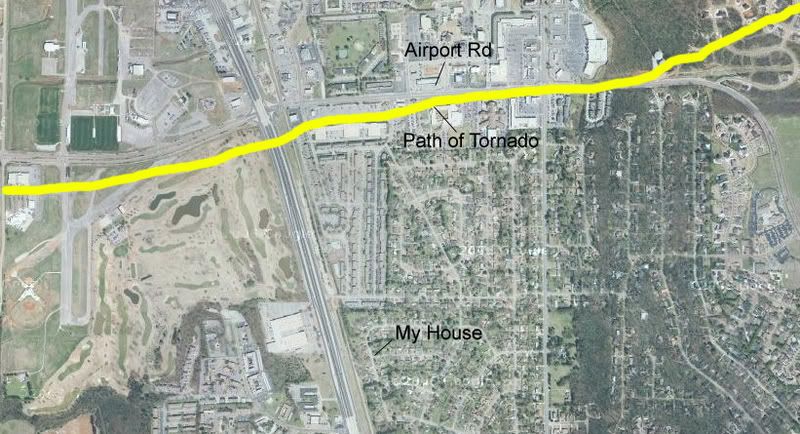
I've been meaning to write about the tornado for many years. I even made a decent start at it several years ago, when I was living in New Orleans (pre-K). I dug around the archives of the Huntsville Public Library, spent a small fortune at the microfiche and xerox machines, and even copied a few video clips. Maybe it's time to take that back up. It's a pretty big deal in terms of Huntsville, a major marker in my young life, and it's definitely an event worth remembering. I guess we'll see if I can get the schwerve back.
Anyway, tonight I will pour one out in honor of the Tornado of '89, its victims, and its survivors.
UPDATED: Here's an email I got from Papa Bear discussing more of what happened for them.
"The Boeing group I worked in had just won another 3 - 5 year contract. There was supposed to be a "win party" at a "German" restaurant over on University Drive, east of Jordan Lane on the south side of University, that's now closed. We had dropped you and Cynthia up the street at the Pumphrey's house. I recall that Shelby and Janie were at dance class in the shopping center across from Grissom High School on Bailey Cove Road. We were just getting ready to leave the house, and we were waiting for the rain to lighten up a bit before leaving for the restaurant. (Otherwise, we'd have been stuck on Airport Road just when the main funnel went down it.) The train had just gone south along the tracks about 10 minutes earlier. I went to the bathroom before leaving and heard a low rumbling like the diesel locomotive through the open window. I wondered, "Why is the train backing up? It just went down and hasn't had time to get to Lily Flagg or Weatherly Road yet." Then I thought, "Wait a minute, that's not a train!" So, I zipped up and out and told your mother to get into the hallway and close the doors, that there was a tornado close by. I threw a couple of flashlights and hardhats into the hall and went to look out the carport and back to see if I could hear or see where the tornado was. The main noise was from the west, but there seemed also to be a secondary noise from the southwest, toward Golf and Martin Roads. So, I went back in, and we sat in the hallway until the sound faded away. Then I went back out to listen for more tornados.
Soon afterwards, we drove up in the old Dodge van to check on y'all. I took Sue over to get her two kids from the dance class. It was a long and careful trip because there was no power, there was debris around and traffic, and it was dark.
Later, I heard the real train coming back. I grabbed my gas lantern, went out and flagged them down behind our house. They asked why I flagged them down. They didn't have a radio with them and couldn't have heard it over the train noise anyway. I told them that a major tornado had gone up Airport Road a couple of hours earlier and I wasn't sure what was on the tracks or even if the tracks hadn't been ripped loose. I went with them up the tracks almost to Airport Road, and after they saw the damage they decided to park the train just north of us for the night (it was a couple of days before they could get it across Airport Road) and used our phone to call in and get picked up. They sent me a note of thanks."
I still remember I went to the dentist that morning, where the nurses talked about the bad weather that was being predicted (we had been placed under a 'high risk' area for severe weather by the National Weather Service). I remember class that day, the tornado drill they made us do, and I remember going up to a neighbor's house with Baby Sister when the parents were supposed to go to a dinner. I remember looking out the window and seeing the black sky a few moments before the power went out and the weather got really bad. I remember sitting in the dark hallway, waiting for my parents to come get us.
They came after an hour or so, waiting to make sure the worst of the weather had cleared. Trees were down all over the place; we were a half-mile from Airport Road, where the tornado had cut through, so even the short drive up the street was treacherous. I don't like to think about it much, but the parents would have been in the path of the tornado had Papa Bear not decided to head back to the house to let the storm pass before heading out to a coworker's retirement dinner.
I remember sitting in the kitchen, some neighbors hanging out at our house, talking, by the light of the camping lantern. Word had begun to trickle in about the damage. Phones were down, but the radio was on and reports had come in that Airport Road, the area that held all our local grocery stores and gas stations, was completely leveled. Reports were coming through about the children trapped at Jones Valley Elementary. I read my book, The Westing Game, and don't remember much about it.
But I do remember my father and another neighbor racing through the house, grabbing a hard hat (why my father had a hard hat I don't know, I suppose he was Mr. Always Prepared) and another camping lantern and sprinting out the back door. If you've ever met Ernest, you know what an impressive feat this is. ANYWAY. There are train tracks that run North-South behind our house, along South Parkway.

The train had no communication with the city and had no idea that the tracks ahead were covered with debris from the apartment complex and rescue workers digging bodies out of said debris. My father waved down the train with the lantern and stopped the train. True story. There was a letter to the editor about it in the Huntsville Times a few days later from a neighbor. +10 for Papa Bear. For what its worth, trains no longer run along those tracks, that I know of.
The next day at school was pretty intense. A few kids from our class had been directly involved in the storm and there was drama when they appeared, late, cut up and bruised, but there nonetheless. There were loads of 'stories' floating around, such as the alleged report of multiple tornadoes in the vicinity (which seem to be false since they were never confirmed, not that multiple funnels are out of the question with a storm that big). There was the story of cops looting the jewelry store that was hit. Then there were the true stories of the painters at Jones Valley Elementary whose heroic efforts saved the lives of several children (one of the painters later died of cancer, a tragic story that was a big deal in the area). And there was the story of the husband and wife owners of a dry cleaners that were killed when the tornado made a direct hit on the shopping center where they worked.
18 years later and Airport Road still resembles the Airport Road of November 14th, 1989. The Apartment complex was rebuilt, as was the Westbury Shopping Center. Some separate standing stores were never rebuilt while new ones went up. New, bigger shopping centers were built where there had only once been empty land. If nothing else, the rebuilding of the area opened up the commercial development of the area. Regardless of the thriving nature of the area now, there still stands a small, simple memorial to the victims of the tornado at the corner of Airport Road and Whitesburg Drive.
I've been meaning to write about the tornado for many years. I even made a decent start at it several years ago, when I was living in New Orleans (pre-K). I dug around the archives of the Huntsville Public Library, spent a small fortune at the microfiche and xerox machines, and even copied a few video clips. Maybe it's time to take that back up. It's a pretty big deal in terms of Huntsville, a major marker in my young life, and it's definitely an event worth remembering. I guess we'll see if I can get the schwerve back.
Anyway, tonight I will pour one out in honor of the Tornado of '89, its victims, and its survivors.
UPDATED: Here's an email I got from Papa Bear discussing more of what happened for them.
"The Boeing group I worked in had just won another 3 - 5 year contract. There was supposed to be a "win party" at a "German" restaurant over on University Drive, east of Jordan Lane on the south side of University, that's now closed. We had dropped you and Cynthia up the street at the Pumphrey's house. I recall that Shelby and Janie were at dance class in the shopping center across from Grissom High School on Bailey Cove Road. We were just getting ready to leave the house, and we were waiting for the rain to lighten up a bit before leaving for the restaurant. (Otherwise, we'd have been stuck on Airport Road just when the main funnel went down it.) The train had just gone south along the tracks about 10 minutes earlier. I went to the bathroom before leaving and heard a low rumbling like the diesel locomotive through the open window. I wondered, "Why is the train backing up? It just went down and hasn't had time to get to Lily Flagg or Weatherly Road yet." Then I thought, "Wait a minute, that's not a train!" So, I zipped up and out and told your mother to get into the hallway and close the doors, that there was a tornado close by. I threw a couple of flashlights and hardhats into the hall and went to look out the carport and back to see if I could hear or see where the tornado was. The main noise was from the west, but there seemed also to be a secondary noise from the southwest, toward Golf and Martin Roads. So, I went back in, and we sat in the hallway until the sound faded away. Then I went back out to listen for more tornados.
Soon afterwards, we drove up in the old Dodge van to check on y'all. I took Sue over to get her two kids from the dance class. It was a long and careful trip because there was no power, there was debris around and traffic, and it was dark.
Later, I heard the real train coming back. I grabbed my gas lantern, went out and flagged them down behind our house. They asked why I flagged them down. They didn't have a radio with them and couldn't have heard it over the train noise anyway. I told them that a major tornado had gone up Airport Road a couple of hours earlier and I wasn't sure what was on the tracks or even if the tracks hadn't been ripped loose. I went with them up the tracks almost to Airport Road, and after they saw the damage they decided to park the train just north of us for the night (it was a couple of days before they could get it across Airport Road) and used our phone to call in and get picked up. They sent me a note of thanks."
Subscribe to:
Posts (Atom)